Thoughts on harness aerodynamics
Improving paragliding performance largely comes down to hunting drag:
Optimizing airfoil efficiency through improved lift-to-drag ratios
Reducing wingtip vortices
Minimizing line consumption (from 4 lines down to 3 and 2 lines)
Reducing pilot parasite drag by transitioning from upright to reclined seating, using pod harnesses, and aerodynamic fairing design.
But what is the relative influence of these different factors?
At best glide speed, total drag is roughly broken down as follows:
50% induced drag (directly linked to wing lift)
50% parasite and friction drag, divided roughly equally between canopy fabric friction, suspension lines, and the pilot. (The cross-sectional area of 250m of line with an average diameter of 0.8mm equals 0.2 m², roughly comparable to a modern competition harness measured in a wind tunnel.)
At higher speeds (on bar), induced drag decreases as lift coefficient drops, while parasite drags increase with the square of airspeed (v²), though exact real-world proportions vary.
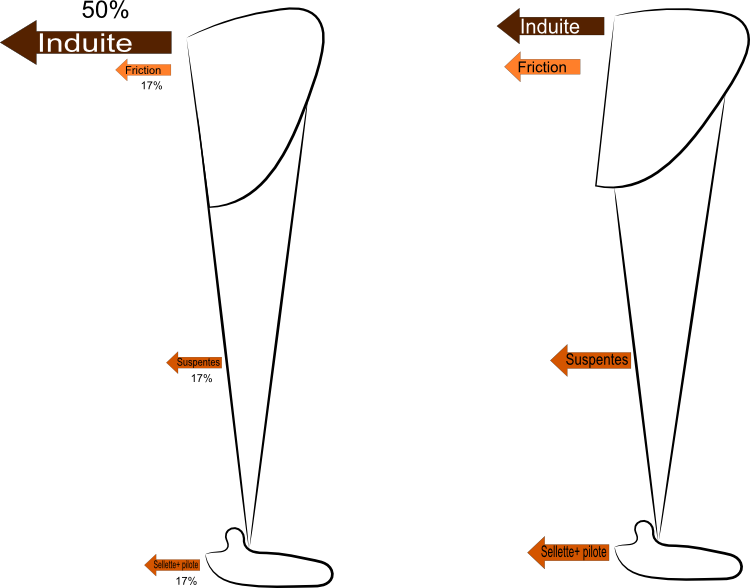
Pilot drag therefore accounts for approximately 20% to 25% of total paraglider drag.
Assuming we could cut this pilot drag by 50% (equivalent to a frontal area of 0.1 m²), we could theoretically gain 1 full point of glide ratio on a wing with a base glide of 10.
However, in practice, moving from an upright sitting posture to a reclined position (theoretically dropping projected area from ~0.35 m² to 0.2 m², a 40% reduction) did not translate into the expected theoretical glide increase.
Similarly, the arrival of various rear-faired competition harnesses did not produce dramatic performance leaps, despite base drag (wake separation) being a notorious drag contributor in aerodynamics.
We wanted to understand why. Without the budget for large-scale wind tunnel campaigns, we turned to computational fluid dynamics (CFD) simulation—not under any illusions regarding absolute values, but relying on their strong comparative accuracy.
Multiple fairing geometries were designed and evaluated. The goal was to study total drag as well as dissecting lift and induced drag generated by the fairing itself.
Soon, another crucial dimension emerged: the polar curve of these shapes across angles of attack. An exquisitely aerodynamic shape is useless if the pilot cannot hold it at its optimum incidence in turbulent air! In paragliding, angle of attack shifts by over 5° across different flight regimes and speed bar travel, with no automated control surface to maintain attitude.
Tuft testing photos on our current Kanibal Race compared with CFD flow trajectories confirmed that while simulations are naturally cleaner than turbulent reality, the flow trends were remarkably consistent.
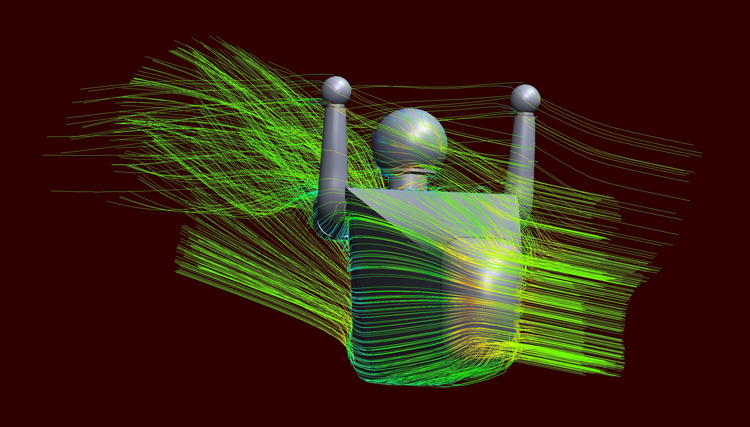
The modeled shapes included:
Current Kanibal Race.
Conical / pointed fairing designs commonly seen.
Boat-tail / wedge-shaped rear fairings to avoid negative downforce.
Head and shoulder fairing contours of various profiles.
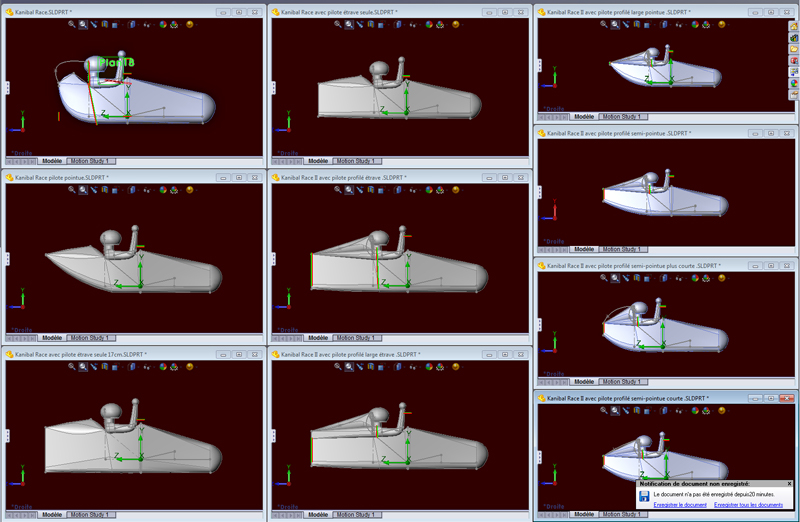
Without overwhelming you with raw data: compared to the current Kanibal Race, standard pointed fairings provide virtually no measurable benefit—partly because they fail to address the root wake separation, and partly because the ram-air scoops required to inflate them generate their own parasitic drag.
Remarkably, for current geometries, having the relative airflow arrive slightly from below (around a 10° upward angle, corresponding to a very flat, nose-up pilot trim) is far more aerodynamically advantageous than keeping the pod perfectly aligned with the flight path.
Because the major drag culprit is the upper body—shoulders, neck, helmet, and arms—airflow arriving slightly from below allows the pod body to “shield” these turbulent areas, smoothing the global wake. Having feet pointed downward is aerodynamically catastrophic.
So stop teasing your friends who fly with their feet pointing high—they're actually the ones doing it right!
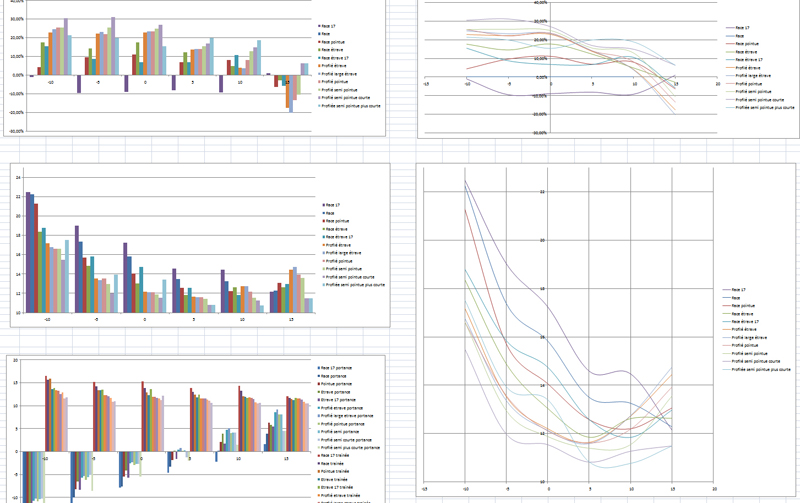
Clean fairing integration around the head, neck, and shoulders also provides clear, quantifiable gains.
Wedge / boat-tail fairings perform well, but show high sensitivity to incoming airflow angle.
Endlessly lengthening the rear tail cone brings diminishing returns—any minor pressure recovery is offset by added skin friction from increased wetted surface area.
Certain fuselage profiles tolerate variations in airflow angle far better than others.
In conclusion, maximum potential gains from an optimal harness shape and perfect pitch attitude are roughly 20% of the harness's 20% share of total drag—a net reduction of 4% to 5% overall drag, and likely even less in turbulent real-world conditions. This equates to glide ratio improvements on the order of a few tenths of a point. In top-tier competition, however, tenths of a glide point make all the difference.